A tree already standing
is worth more than
a tree you plant.
Semi-mature trees carry fifteen to forty years of growth that cannot be bought back at any price. When a road widens or a plot is redeveloped, that value is usually written off in an afternoon. It does not have to be.
- 25,000+
- Trees and palms transplanted
- >95%
- Survival at 12 and 24 months
- Nov–Mar
- Preferred Gulf lifting window



Replacement is not the same as replanting.
Removing a mature tree and planting a sapling somewhere else is not a like-for-like exchange. The sapling will take a decade or more to deliver the canopy area, the surface cooling, the habitat and the visual maturity that was cut down.
Transplantation keeps all of it on the same programme. It is competitive on cost the moment you value the canopy rather than the plant, and it is decisive on any project with a tree retention condition, an environmental reporting obligation, or a client who will notice that the courtyard is bare.
- Ball diameter
- 10 to 12 times trunk calibre
- Ball depth
- 60 to 75 per cent of ball diameter
- Root pruning
- Staged over 2 to 3 visits, 4 to 8 weeks apart
- Preparation window
- 3 to 6 months for a planned move
- Establishment care
- 12 to 24 months, monitored
- Survival assessed
- At 12 and again at 24 months
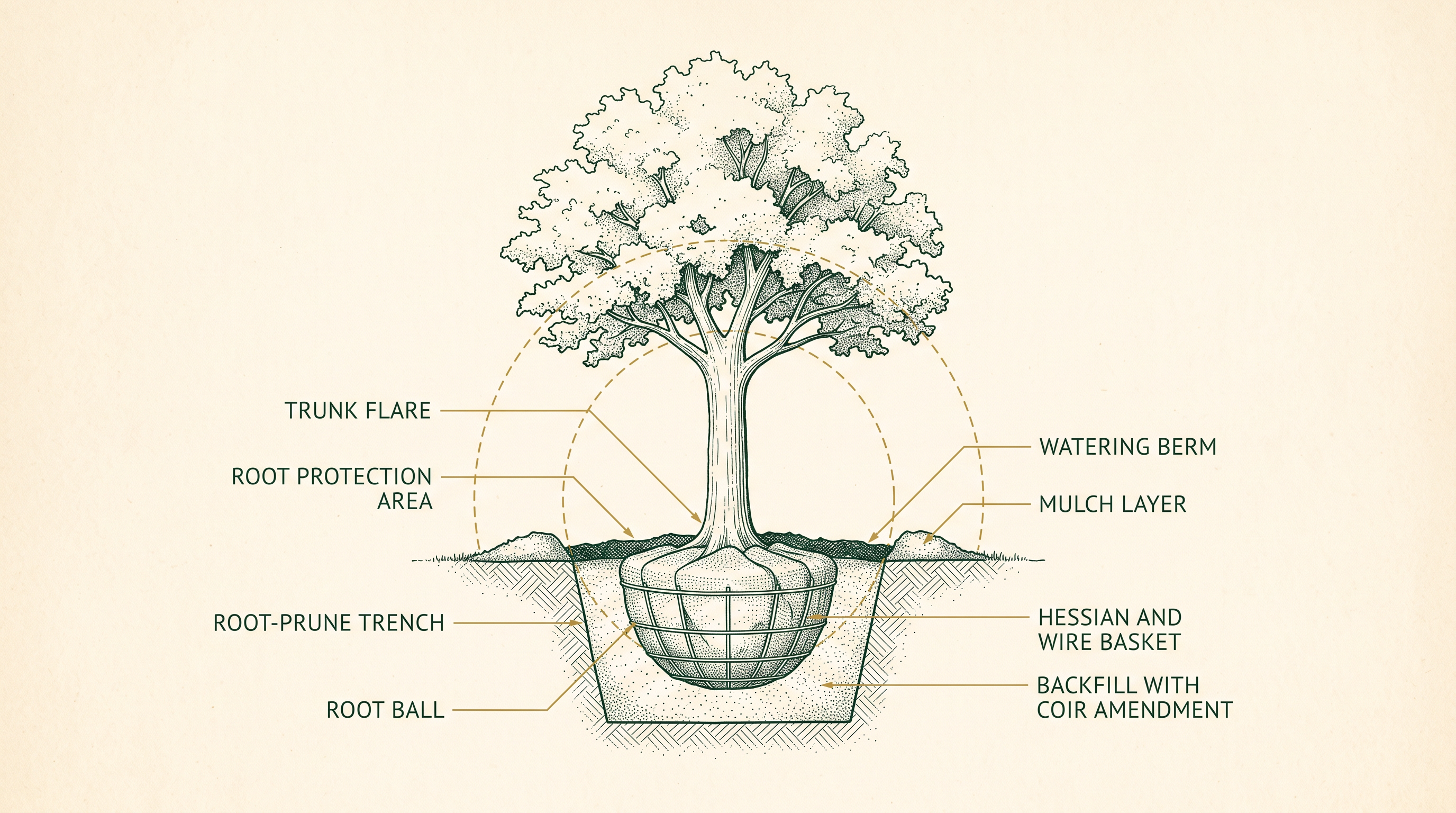
- Assess. Some trees are declined here.. Species, calibre, health, root architecture, access at both ends. The decision not to move a tree is cheaper now than it is after the crane is booked, and we make it in writing.
- Root prune. The ball is grown, not just cut.. Trenched in stages across two or three visits, four to eight weeks apart, so the tree grows fine feeding roots inside the volume you intend to lift. This is the step that decides survival, months before anything moves.
- Bind and lift. A ball that cracks in the air has already failed.. Wrapped in hessian and a steel wire basket before it leaves the ground, crown tied upward, tag lines held taut from below. The rigging is engineered to the wet weight, not the dry one.
- Transport. Level, covered, and fast.. Root plate kept level, ball kept damp and shaded. Time between lift and replant is the single variable that most reliably predicts whether the tree lives.
- Replant. Into a pit that was ready before it arrived.. Set at the original soil level, backfilled with amended native soil, braced below the crown, watered in to close voids. Then assessed at 12 months and again at 24 against defined criteria.
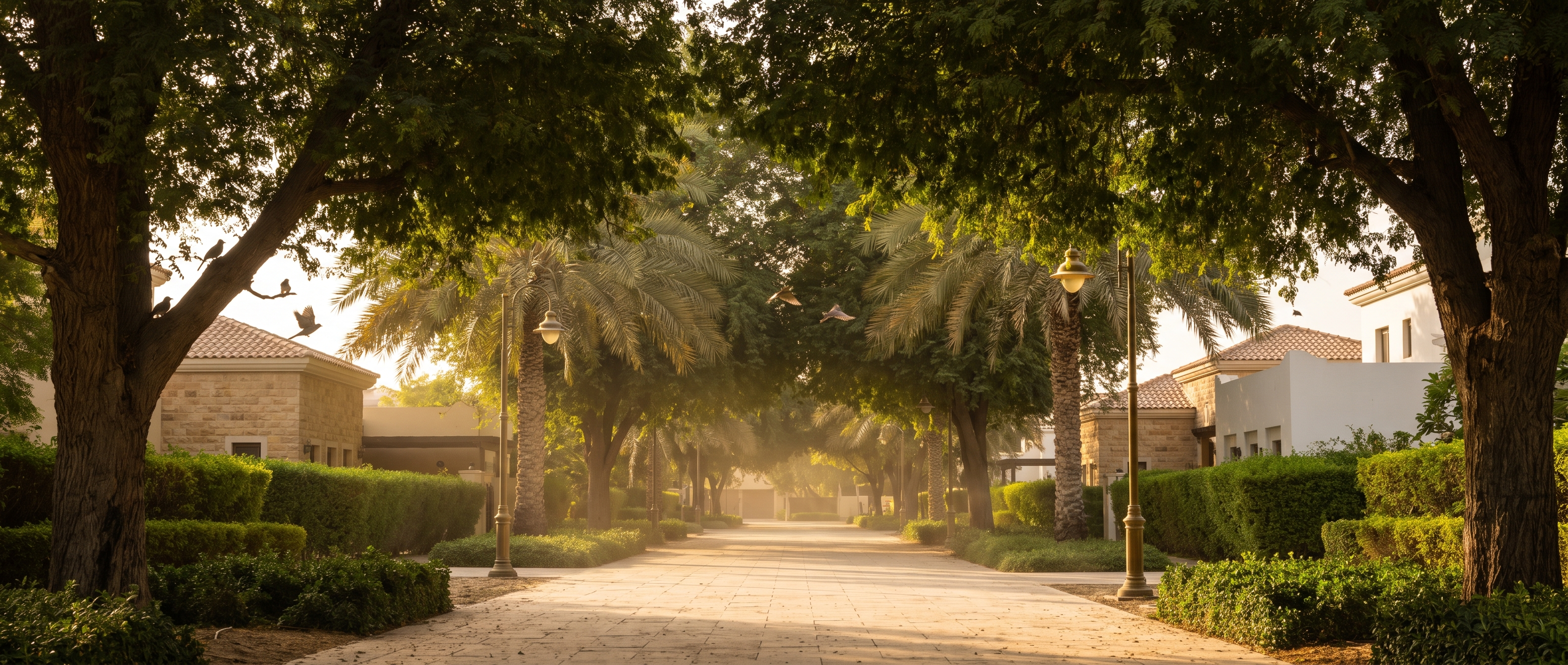
Maturity onhandover day.
A newly completed community that already reads as twenty years old. That is what transplantation buys.
And here it isactually happening.
The sequence above is a commissioned illustration of the method. What follows is the method being carried out, photographed on the sites where the record was built.
Assess and root prune. Species, calibre, health and root architecture, then the ball is trenched in stages across two or three visits four to eight weeks apart, so the tree grows fine feeding roots inside the volume you intend to lift. Photograph: Excavating and binding root balls before the lift. Reduce and protect the crown. Crown reduced to rebalance what the remaining roots can supply, then sheeted. Wind across an unprotected canopy on a moving trailer does more damage than the lift itself. Photograph: Crown-reduced specimen sheeted for transport. Bind the ball, then lift. The ball is wrapped and bound before it leaves the ground. A ball that cracks in the air has already failed, whatever happens afterwards. Photograph: Telehandler lifting a mature palm on a bound root ball. Stage and transport. Balls kept covered and damp, root plate level, crowns tied. Time between lift and replant is the single variable that most reliably predicts whether a tree lives. Photograph: Palms staged with bound root balls, ready for replanting. Replant, brace, monitor. Into a pit prepared before the tree arrives, set at the original soil level, backfilled with amended native soil, braced below the crown, watered in to close voids — then assessed at 12 and 24 months. Photograph: Replanted tree, braced and irrigated in a prepared pit.
Root ball calculator
Size the ball before you size the crane. Adjust for soil, because the same tree in sand and in clay does not take the same ball, and the wet weight is what the machine actually has to lift.
Measured at 150 mm above ground for stock under 300 mm, at 1.4 m for larger trees.
Palms regenerate roots from the base rather than from cut root ends, so they move on a much smaller ball relative to their size. The fronds are tied and the crown is protected instead.
The reference case the rule of thumb was written for.
Indicative only, and never a lifting plan. Ball geometry is adjusted on site for actual root architecture, irrigation history, previous transplanting, buried services, and crane capacity and reach. Depth is capped at 3 m because below that you are lifting subsoil rather than working roots. Where the machine cannot lift the ball the tree needs, the answer is a bigger machine, not a smaller ball.
The arithmetic behind this, including where the rules of thumb break down, is set out in root ball sizing: the numbers, and where the rules of thumb break.
How survival is actually measured
A survival percentage claimed on the day of replanting means nothing. Every tree we move is entered in a register with species, calibre, source and receiving coordinates, dates, method and condition.
It is then assessed at 12 months and again at 24 against defined criteria: live cambium, new root growth outside the original ball, leaf area consistent with the species, and no progressive dieback. A tree that is alive but declining is recorded as a failure, not a success. That is the only way a number above 95 per cent means anything.
The details that decide it


Answered directly
Can a mature tree really be moved without killing it?
Yes, and it is done routinely at scale. Survival is decided long before the crane arrives: by root pruning the tree in stages so it grows a compact feeding root system inside the ball you intend to lift, by cutting a root ball sized to the trunk calibre rather than to the machine on site, by protecting the ball from drying between lift and replant, and by irrigating and monitoring for at least one full seasonal cycle afterwards. Where that sequence is followed our record across more than 25,000 transplanted trees and palms is above 95 per cent survival.
How big should the root ball be?
The working rule used across the industry is roughly 10 to 12 times the trunk calibre in root ball diameter, measured at 150 mm above ground for smaller stock and at 1.4 m for large stock, with depth typically 60 to 75 per cent of the ball diameter. A 300 mm calibre tree therefore needs a ball around 3.0 to 3.6 m across and 1.8 to 2.4 m deep, which will weigh in the region of 8 to 18 tonnes depending on soil moisture. Palms are different: they are moved on a far smaller ball relative to their height because their root system regenerates from the base rather than from cut root ends.
How long does the whole transplantation process take?
For a healthy tree that can be prepared properly, allow three to six months. Root pruning is staged over two to three visits at four to eight week intervals so the tree can respond, then the lift and replant happens in a single day per tree, then establishment care runs for twelve to twenty-four months. Emergency transplantations compressed into a single week are possible and are sometimes the only option, but survival probability drops and that trade-off should be stated in writing before the work starts.
What is the best time of year to transplant trees in the UAE?
The window from November to March is strongly preferred. Transplant shock is a water-balance problem — the tree loses its root capacity on the day it is lifted while keeping its full canopy demand — so moving during Gulf summer, when evaporative demand is at its peak, stacks the odds against the tree. Where a programme forces a summer lift, survival can still be protected with heavier crown reduction, shade cloth, anti-transpirant treatment and a much more aggressive irrigation regime, but the cost of care rises.
How is survival actually measured?
Survival should never be a claim made on the day of replanting. We assess at 12 months and again at 24 months against defined criteria: live cambium, established new root growth outside the original ball, a leaf area index consistent with the species, and no progressive dieback. A tree that is alive but declining is recorded as a failure, not a success. Every transplantation is registered with species, calibre, source and receiving coordinates, dates and assessment results, and that register is what the survival percentage is drawn from.
Send the species, the calibre and a photograph.
With those three things and the access conditions at both ends we can tell you whether the tree should be moved, what it will take, and whether we would decline it.